
Categories
Latest Cable Recycling Machine and Industry News

SUNY GROUP Chinese New Year Holiday Schedule Notice

Our Chinese New Year holiday will take place from February 13th to February 23rd, 2026. During this period, factory production and shipment activities will be temporarily suspended. Normal manufacturing operations will resume on February 24th, 2026.

Although our production floor will be at rest, our commitment to sustainability continues. Throughout the holiday, our team remains available for technical consultation, process discussions, and preliminary system planning, ensuring that project ideas and collaboration continue to take shape. Detailed engineering design, manufacturing, and delivery arrangements will be carried out immediately upon the resumption of factory operations.

SUNY GROUP Chinese New Year Holiday Schedule Notice

To support customers planning recycling projects for the year ahead — including Tetra Pak / Milk Carton recycling systems, cable recycling systems, aluminum-plastic separation lines, baby diaper recycling machine, and composite packaging recycling solutions — we encourage early order confirmation. Orders finalized prior to the holiday will be given priority in post-holiday production scheduling, helping projects move forward without delay.

SUNY GROUP remains committed to providing reliable recycling technologies and professional support to customers worldwide. We sincerely appreciate your continued trust and cooperation and look forward to advancing sustainable recycling solutions together in the coming year. We wish all our partners a prosperous, successful, and healthy Chinese New Year.

We are a professional manufacturer of recycling machinery and equipment. Our professional technology and considerate service will provide you with the most reasonable personal solution. For more machine information, or to schedule a factory visit (in-person or virtual), feel free to contact our sales team.

Contact Tel: +86 199 0388 6476
Contact Email: zyunfei87@gmail.com
Categories
Latest Cable Recycling Machine and Industry News

How to Get Clean Copper Granules from Scrap Cables

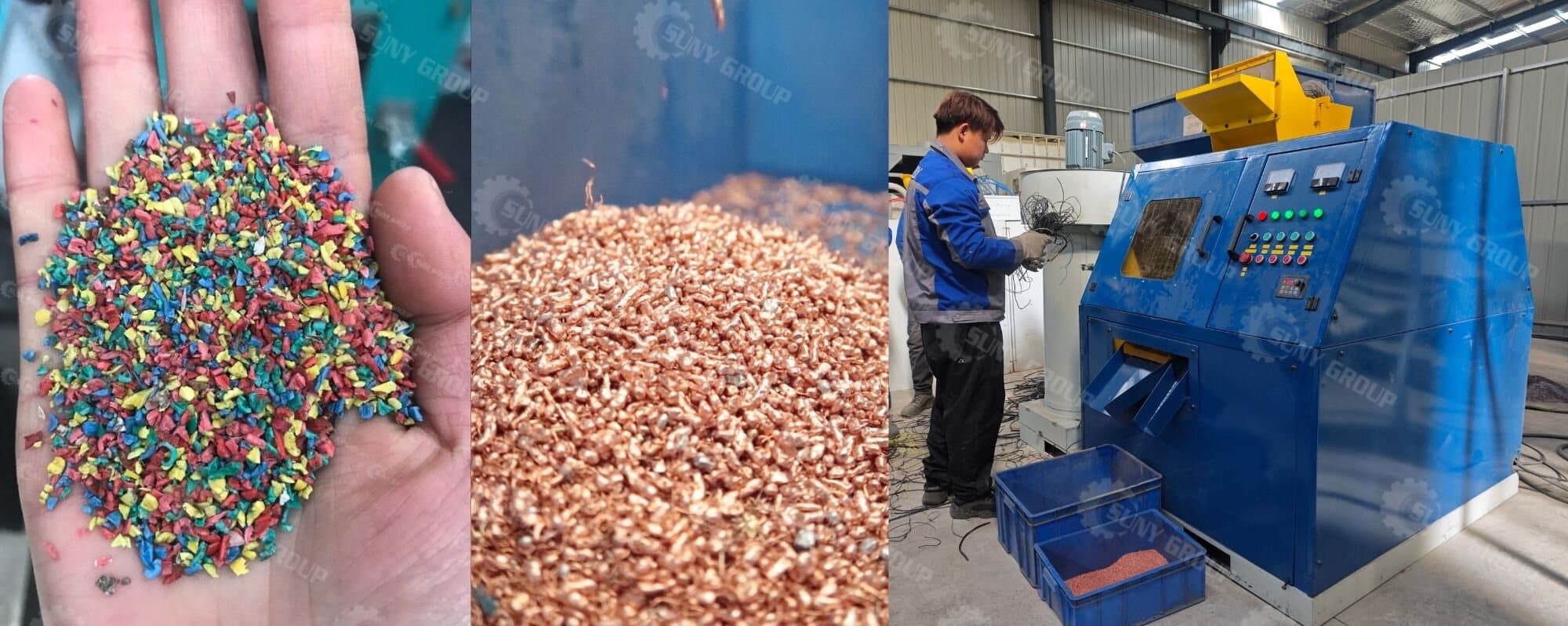
Recovering clean copper granules from scrap cables is often described as a technical challenge, but in reality, the difficulty lies less in the material itself and more in how the process is designed and controlled. For recyclers handling large volumes of waste copper wire, manual stripping is slow, labor-intensive, and increasingly uneconomical. Mechanical granulation combined with physical separation has therefore become the mainstream solution, especially when dealing with mixed, fine, or irregular cables.

Scrap cables vary widely in structure and composition, including automotive wiring harnesses, household appliance wires, communication cables, and computer wires. These materials cannot be processed efficiently using a single, simplistic method. What ultimately determines the economic outcome is not the quantity of scrap fed into the system, but whether the operation can consistently produce copper granules that meet market purity requirements. Clean copper sells faster, commands higher prices, and requires no additional downstream processing.

Get Clean Copper Granules from Scrap Cables
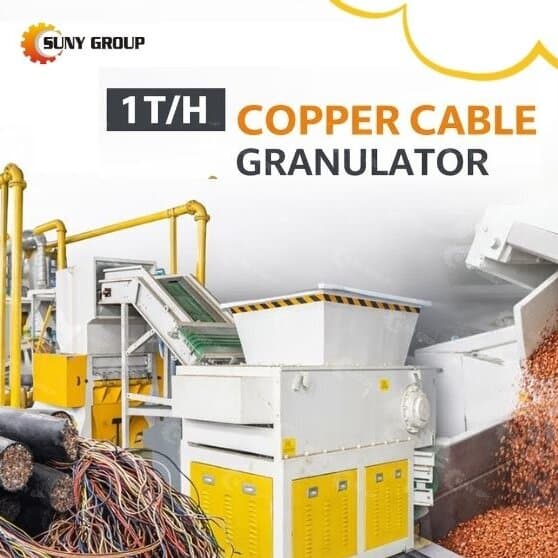
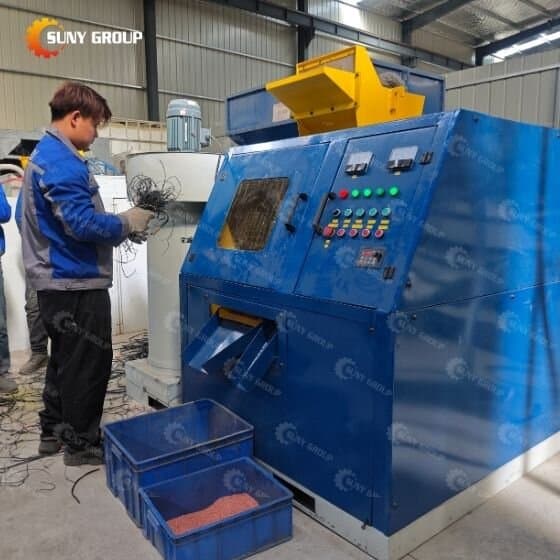
Cable Wire Granulator

In mature recycling markets, physical separation has largely replaced burning and chemical treatment. Unlike traditional methods, physical processes do not generate wastewater, toxic emissions, or secondary pollution. They rely on controlled crushing, airflow, screening, and density differences to separate copper from insulation materials. This makes the process more stable, more compliant with environmental regulations, and easier to scale for long-term operation.

The quality of the final copper output depends heavily on process details. Crushing must be carefully controlled: particles that are too large prevent full liberation of copper, while excessive grinding increases dust and metal loss. Separation efficiency also improves significantly when multiple stages are used rather than a single pass. Stable airflow is particularly important, as even small fluctuations can result in plastic contamination or copper loss. These details, often overlooked, are what distinguish clean, market-ready copper granules from low-grade mixed material.

Waste cables are frequently described as “high-value scrap,” but value is only realized when recyclers can convert them into consistently clean, high-purity copper granules. The difference between copper that merely looks valuable and copper that is truly profitable lies in understanding cable structures, choosing the right physical separation route, and optimizing each step of the process. When these elements are aligned, cable recycling becomes not just technically feasible, but commercially reliable.

Contact Tel: +86 199 0388 6476
Contact Email: zyunfei87@gmail.com
Categories
Latest Cable Recycling Machine and Industry News

1000 kg/hr Copper Cable Granulator Process Flow Description

The Copper Cable Granulator Line features a linear, modular layout and operates with fully dry mechanical technology to ensure stable performance and easy maintenance. Scrap cables are fed by conveyor into a single-shaft shredder for pre-shredding, then pass through a magnetic separator to remove ferrous impurities. The material is subsequently granulated to fully separate copper from insulation and conveyed by air systems to the separation section. Multi-stage air separators and vibrating screens efficiently separate light plastics from heavy copper granules, while optional electrostatic separators further increase copper purity when required. Pulse-jet dust collection systems control dust throughout the process. The line outputs clean copper granules and plastic fractions ready for sale, and the configuration can be flexibly adjusted to suit different materials, site conditions, and capacity requirements.

1000 kg/hr Copper Cable Granulator Process Flow Description (Engineering Specification – Equipment No. a–k)

a) Feeding Conveyor
The feeding conveyor is designed to provide continuous and controlled feeding of scrap copper cables into the recycling line, ensuring stable material input for downstream processing.

b) Single-Shaft Shredder
The single-shaft shredder is used to pre-shred scrap cables into uniformly sized pieces. This stage reduces material size and facilitates consistent granulation performance.

c) Belt Magnetic Separator
The belt magnetic separator is installed to remove ferrous materials from the shredded cables, preventing damage to downstream equipment and improving overall system reliability.

d) Discharge Conveyor
The discharge conveyor transfers material from the magnetic separation stage to the fine granulation stage, maintaining a steady and uninterrupted material flow.

e) Knife-Type Granulator
The knife-type granulator is designed to finely granulate the pre-shredded cables, ensuring complete liberation of copper conductors from plastic insulation.

f) Air Conveying System (×2)
The air conveying units are used to transport granulated material to the separation section in a closed system, reducing dust emission and ensuring continuous operation.

g) Air Separator (×2)
The air separators utilize controlled airflow and density differences to separate light plastic fractions from heavy copper granules, achieving primary copper–plastic separation.

h) Linear Vibrating Screen – Copper Fraction (×2)
The linear vibrating screens classify copper-rich material by particle size, directing qualified copper granules to subsequent purification stages or final discharge.

i) Linear Vibrating Screen – Plastic Fraction (×2)
The linear vibrating screens are used to screen and discharge plastic fractions separately, ensuring clean plastic output suitable for secondary recycling.

j) Single-Roller Electrostatic Separator (×2)
The single-roller electrostatic separators are applied to remove residual fine plastic particles from the copper fraction, increasing copper purity to meet high-quality output requirements.

k) Pulse-Jet Dust Collection System (×2)
Pulse-jet dust collection systems are installed at key process points to capture airborne dust generated during shredding, granulation, and separation, ensuring compliance with environmental and occupational safety standards.

Contact Tel: +86 199 0388 6476
Contact Email: zyunfei87@gmail.com